PHP & Web Development Blogs

Showing 6 to 9 of blog articles.
12846 views · 6 years ago


Welcome back! If you’re new to this series have a look at Part 1 here


Today’s focus is on templating, the aesthetic that will make or break your web application.

Having a clean design with well defined CSS that’s responsive and user friendly goes a long way.

Developers often stick to their lane but delving into templating will bode in your favor, you can indeed
create a functional and launch-worthy application all on your own!

Let’s jump into it!

Structured structure


Everything you tackle should be found with ease down the line. Therefore careful planning is fundamental to the success and sustainability of your project. You’ll also find that clearly defining your work lends itself to more productivity overall as you spend less that explaining your work during a handover / looking for a specific piece of code or resource. You’ll probably end up spending more time on actual work.
Finding your own unique pattern with file structure and CSS identifiers will also work in your favor as something unique to your process will most likely be easier to remember and form a tactile relationship with.

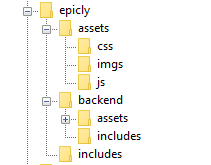
Our project’s current structure looks like this:


>If you need to backtrack, Part 1 is a great place to start!

In part 1, we created our index.php which displays info from our database.

Let’s take this a step further and create a header and a footer for our index.php

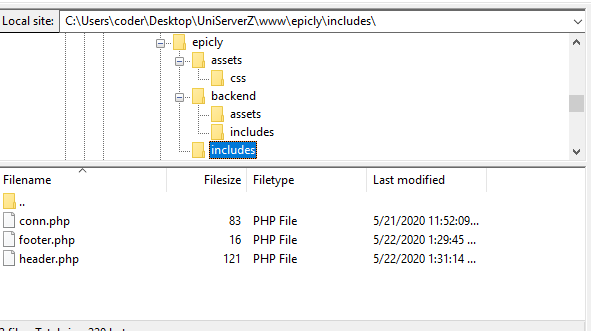
Create a file called header.php and save this to your includes folder.

Next, create a file called footer.php and save this to your includes folder.

Your file structure should now look like this.


A header above all the rest


The header file will be a file we reuse throughout your web application. This file will contain important information that’s vital to the functionality and aesthetic of your website.
The type of info you’ll expect to see in a header.php file:
Script includes
Such as JQuery and important libraries
CSS includes
CSS files loaded from internal or external sources
Meta information
Contains important information that’s readable by search engines.
The basic structure of the beginning of your app, including your menu, and your logo.
For now, how header is going to have a basic layout.

Let’s get our HTML on!

<html>
<head>
<title>My Awesome CMS – Page Title</title>
</head>
<body>


A footer that sets the bar

Create a file called footer.php and save it to your includes folder (yourcms/includes/footer.php).

Add this code to your new file.

</body>
</html>


Next, let’s focus on the gravy… The CSS


CSS, when written beautifully, can truly set you apart.

You can tell your web application to load various styles to specific elements by defining unique identifiers.
Styles that are only used once are denoted with a # (a CSS “ID”) whereas styles that are reused multiple times are denoted with a . (a CSS “class”)

The best way to delve into the realm of CSS is to learn by experience.

Let’s create!


First, we need to create and load our CSS file. Remember our nifty new pal header.php? This created a convenient way to load our CSS file!

Add the following code to your header.php just above the </head> tag.

<link href=”../assets/css/style.css” type=”text/css” rel=”stylesheet”/> 


The ../ in the link to our stylesheet means we have to leave the current directory (the directory that header.php is in) and look for the assets/css/ directories.

Go ahead and create the css folder under your assets folder.

Next we’re going to create some simple CSS to test things out.

It’s time to add some style!


We are going to create two divs.
A div is a divider / section in HTML.
Add this to your index.php (located in your CMS’ root folder) above the <?php tag.

<div id="myfirstid"></div>
<div class="myfirstclass"></div>


Then, create a CSS file

Add this:

#myfirstid{
Background:lightblue;
Font-family:Arial;
Font-size:44px;
Font-weight: Bold;
}
.myfirstclass{
Font-size:15px;
Color: darkblue;
}


Save your newly created CSS to assets/css/ as style.css.

Pulling it all together, let’s see what we can do!


Let’s apply what we just learned to our index.php. But first, we should add our header.php and footer.php files.

Including everyone


Add this to the top of your index.php file:

include(‘includes/header.php’);


Remove the <divs> we used for practice earlier, we have something better in store!

Add this to the bottom of your index.php:

include(‘includes/footer.php’);


Next, let’s modify our code so we can add some style to the data we retrieve from our database.

Modify the following line:
foreach($getmydata as $mydata){ echo "Title: "; echo $mydata['title']; echo "<br/>"; echo "Content: "; echo $mydata['content']; echo "<br/>"; echo "Author: "; echo $mydata['author']; echo "<br/>"; echo "<br/>";


as follows:
?>

<div id=”myfirstid”>
<?php
foreach($getmydata as $mydata){
echo "<div class=”myfirstclass”>Title: ";
echo $mydata['title'];
echo "<br/>";
echo "Content: ";
echo $mydata['content'];
echo "<br/>";
echo "Author: ";
echo $mydata['author'];
echo "</div><br/><br/>";
}?>
</div>
<?php


Your full index.php should now look like this:

<?php
include('includes/header.php');
include('includes/conn.php');

if ($letsconnect -> connect_errno) { echo "Error " . $letsconnect -> connect_error;

}else{

$getmydata=$letsconnect -> query("SELECT * FROM content");

?>
<div id="myfirstid">
<?php
foreach($getmydata as $mydata){
echo "<div class=”myfirstclass”>Title: ";
echo $mydata['title'];
echo "<br/>";
echo "Content: ";
echo $mydata['content'];
echo "<br/>";
echo "Author: ";
echo $mydata['author'];
echo "</div><br/><br/>";
}
?>
</div>
<?php
}

$letsconnect -> close();
include('includes/footer.php');
?>


Go ahead, test it out!

There’s a lot to unpack and I will break things down a little more during our next tutorial!

Challenge


Study the final index.php and try to form a few theories about why closing a php tag is necessary before adding raw html.

Next Up: #CodeWithMe Part 4: Building A Good Base

11433 views · 5 years ago


Welcome back! If you're new to this series have a look at Part 1 here

Today we are going to beef things up a bit and we will focus on the backend and some key CMS functionality.

It's time to get excited, this is where you'll start to see your barebones structure morph into something extraordinary!

Tired of my intro? That's ok! Let's jump into it!

Getting the DB on board


Before we delve into this, it's imperative that we take a minute and plan things out.

The database tables that are vital to any CMS are the menu, the user table, and the content table.

Our menu table will start of as follows:

CREATE TABLE 'mydbname'.'menus' ( 'ID' INT(11) NOT NULL AUTO_INCREMENT , 'menuname' VARCHAR(100) NOT NULL , 'item' VARCHAR(50) NOT NULL , 'itemlink' VARCHAR(100) NOT NULL , PRIMARY KEY ('ID')) ENGINE = MyISAM COMMENT = 'menu table';


Let's break this down a bit.

In the SQL above, we're creating a new table called menus.

Essentially our structure looks like this:

ID | Menuname | Item | Itemlink

Our ID field is our unique identifier (our PRIMARY KEY).

Tip: Remember, you can use raw SQL or a tool like PhpMyAdmin to create your db tables/execute SQL queries.

Next up is our user table.

CREATE TABLE 'mydbname'.'users' ( 'ID' INT(11) NOT NULL AUTO_INCREMENT , 'username' VARCHAR(100) NOT NULL , 'password' VARCHAR(50) NOT NULL , 'email' VARCHAR(100) NOT NULL , PRIMARY KEY ('ID')) ENGINE = MyISAM COMMENT = 'user table';


Visually represented this structure looks like this:

ID | Username | Password | Email

Our ID field is our unique identifier.

And finally, our content table modifications. You probably remember creating a rudimentary content table in Part 1 of the series.

ALTER TABLE 'mydbname'.'content' ADD content_type VARCHAR(50);


Yep, you guessed right, in the above statement we are altering our content table and adding a new field called content type.

Our new table structure now looks like this:

ID | Title | Content | Author | Content Type

Planning to Add to the Backend


Next , we're going to add a menu section, an add user section, and we'll also modify our content section.

Let's do this! reate a file called menus.php in your backend folder.

Next, code a HTML form to save your menu data.

The form needs the following fields:

Menu Name (we called this menuname in our db table).

Menu Item Name (we called this item in our db table).

Menu Link (we called this itemlink in our db table).

Try to follow Part 1 to do this on your own.

If you get a little stuck, that's ok. You can also follow the example below:

<form method="post" action="<?php $_SERVER['PHP_SELF'];?>"/>

<input type="text" name="menuname" class="mytextbox" placeholder="Menu Name" required />

<input type="text" name="item" class="mytextbox" placeholder="Item" required />

<input type="text" name="itemlink" class="mytextbox" placeholder="Item Link" required />

<input type="submit" value="Save Menu Item" name="savemenu" class="mybutton"/>

</form>


Notice the use of CSS classes? The gravy!

This will come in handy in our next tutorial.

Next, let's add the form processing code as we need to save these fields to the database. Remember to use the sanitization technique you learned in Part 2.

Add this above your <form> tag.

<?php

if(isset($_POST['savemenu'])){

include('../includes/conn.php');

if ($letsconnect->connect_error) {

die("Your Connection failed: " . $letsconnect->connect_error);

}else{

$menuname = $letsconnect ->real_escape_string($_POST['menuname']);

$item = $letsconnect -> real_escape_string($_POST['item']);

$itemlink = $letsconnect->real_escape_string($_POST['itemlink']);

$sql = "INSERT INTO menus(menuname,item,itemlink) VALUES ('".$menuname."', '".$item."', '".$itemlink."')";

if (mysqli_query($letsconnect, $sql)) {

echo "Your data was saved successfully!";

} else { echo "Error: " . $sql . "" . mysqli_error($letsconnect);

} $letsconnect->close();

}

}

?>


Ok phew, the menu data capturing section is done.

Let's move on to the user data capturing section, and modify the content capturing screen.

Repeat the steps above and create these two screens. Remember to keep an eye out for our database field names that we defined earlier! If you get stuck, look at the end result below:

Create adduser.php in your backend folder.

Create your data capturing form.


<form method="post" action="<?php $_SERVER['PHP_SELF'];?>"/>

<input type="text" name="username" class="mytextbox" placeholder="Username" required/>

<input type="password" name="password" class="mytextbox" placeholder="Password" required />

<input type="email" name="email" class="mytextbox" placeholder="Email" required />

<input type="submit" value="Save Menu Item" name="saveuser" class="mybutton"/>

</form>


Add your PHP processing code, remember the security!

Add this above your <form> tag.

<?php

if(isset($_POST[‘saveuser])){

include('../includes/conn.php');

if ($letsconnect->connect_error) {

die("Your Connection failed: " . $letsconnect->connect_error);

}else{

$menuname = $letsconnect -> real_escape_string($_POST[‘username']);

$item = $letsconnect -> real_escape_string($_POST[‘password']);

$itemlink = $letsconnect -> real_escape_string($_POST[‘email']);

$sql = "INSERT INTO menus(username,password,email) VALUES ('".$username."', '".$password."', '".$email."')";

if (mysqli_query($letsconnect, $sql)) {

echo "Your data was saved successfully!";

} else { echo "Error: " . $sql . "" . mysqli_error($letsconnect);

} $letsconnect->close();

}

}

?>


Please note that I will be covering Password security in the tutorials that follow.

Make sure that you are using your localhost server to complete this tutorial series. Do not publish your work until you complete this series.

Lastly, let's move to our content capturing screen which is currently found in index.php in the backend folder.

We will be changing this to a more professional dashboard in the tutorials that follow!
Our current file looks like this:


<html>

<head><title>Backend - Capture Content</title></head>

<body>

<?php

if(isset($_POST['savedata'])){

include('../includes/conn.php');

if ($letsconnect->connect_error) {

die("Your Connection failed: " . $letsconnect->connect_error);

}else{

$title = $letsconnect -> real_escape_string($_POST['title']);

$content = $letsconnect -> real_escape_string($_POST['content']);

$author = $letsconnect -> real_escape_string($_POST['author']);

$sql = "INSERT INTO content (title,content,author) VALUES ('".$title."', '".$content."', '".$author."')";

if (mysqli_query($letsconnect, $sql)) {

echo "Your data was saved successfully!";

} else { echo "Error: " . $sql . "" . mysqli_error($letsconnect);

} $letsconnect->close();

}

}

?>

<form action="<?php $_SERVER[‘PHP_SELF'];?>" method="post">

<input type="text" name="title" placeholder="Content Title here" required/>

<textarea name="content">Content Here</textarea>

<input type="text" name="author" placeholder="Author" required/>

<input type="submit" value="Save My Data" name="savedata"/>

</form>

</body>

</html>


We need to modify this slightly to include our new field, content_type.

Add the input field in your <form> above the submit button.


<input type="text" name="content_type" placeholder="Content Type" required/>;


Next, add the content_type to the sanitization lineup.

$content_type = $letsconnect->real_escape_string($_POST['content_type']);


Lastly, store this variable to the database by modifying the $sql.

$sql = "INSERT INTO content (title,content,author,content_type) VALUES ('".$title."', '".$content."', '".$author."', '".$content_type."')";


Conclusion


Chopping and changing is not always as daunting. Find a rhythm. There are many ways to make cumbersome coding a breeze and we will delve into that in the tutorials to come.

Challenge


Think of ways to test what we just did through retrieving and echoing data from the database.

Next Up: #CodeWithMe Part 5 Building a good base Continued

67534 views · 2 years ago


To bridge the gap between web-based and cloud-based applications, businesses often rely on skilled DevOps developers. These professionals play a crucial role in ensuring seamless integration, efficient customization, and robust back-end infrastructure for applications. The expertise of DevOps developers is indispensable for optimizing development workflows and enhancing collaboration between development and operations teams in the dynamic landscape of app development services.

In the realm of cloud computing, web based application in cloud computing play a pivotal role. Technically, web apps, as the name suggests, are applications hosted on remote servers & accessible through web browsers. On the other hand, cloud-based apps are web applications that come with advanced functionalities & elaborate compatibility.


In the realm of contemporary software development, the demand for innovative solutions is evident in the competition between web and cloud-based applications. These two platforms share similarities but diverge significantly in crucial aspects. This article will delve into the distinctions between web-based and cloud-based applications, exploring facets such as back-end infrastructure, scalability, and technical perspectives, shedding light on the nuances that developers navigate in this dynamic landscape, including the pivotal role of technologies like chatbot development.
What Is a Web Application?

A web-based app is an application designed and developed for the web browser. Unlike cloud based application development, the web app completely depends on the web server for functionality & processing. This application program is mainly stored on the remote server & delivered through a web browser interface over the internet. According to web application development company, web apps have client-server architecture & their codes are divided into 2 major components – server-side architecture & client-side architecture.

Server-side architecture: The server-side architecture or script usually deals with data processing. The web server can process a client request & send a response back. This web app architecture defines a simultaneous interaction between database instances, components, user interfaces, middleware systems, and servers.

Client-side architecture: The client-side architecture mainly deals with interface functionalities such as drop-down boxes and buttons. When a user clicks on the link, the browser will start loading the client-side script & rendering a text and graphic element for interaction.
Types of Web Apps
Nowadays, many businesses are already adopting various kinds of web-based applications because of their several advantages, features, and functionalities. 8 most popular types of web apps include:
    . Static Web Apps
Static web applications, constructed using HTML, CSS, and JavaScript, lack the flexibility of dynamic counterparts. These web based services provide content directly to users without requiring server-side modifications, resulting in simplicity and straightforward development. Key benefits of these apps include:
Very fast load time
Highly secure
Less complex to build
    . Dynamic Web Apps
This is a complex type that provides real-time data based on the server response and the user’s request. Dynamic web apps can be developed either as a conventional website with several pages and levels of navigation or as a single-page web application. They use several server-side and client-side languages to create web pages such as HTML, CSS, JavaScript, Python, PHP, Ruby, etc. Key benefits of dynamic web apps include:
Wider audience reach
Scalable in comparison to static web apps
Very flexible in terms of a new content update
    . Single Page Apps
A single page web app entirely runs on the browser & never requires browser reloading. This is actually a dynamic web app that manages all data on a single HTML page. This type of web app is faster than traditional websites as its logic is implemented in the browser directly than a server. Gmail, Netflix, Pinterest & Paypal are the best examples of single page applications. Key benefits include:
Enhanced user experience
Minimized server load
Improved app performance
    . Multiple-Page Apps
Multiple page apps are designed multiple pages separately and combined to form a website. They have different pages with static information like texts & images. Web based app development companies recommend using multiple-page apps as they offer excellent control over search engine optimization techniques. Major benefits of Multiple page apps include:
Ideal for SEO
Quick browser back or forward navigation
Simple to develop
    . Animated Web Apps
This is a type of web application that effectively supports synchronization & animation on the web platform. These applications are widely used by freelancers and creative companies to present their creativity better. Technically, JavaScript, HTML5, FLASH, and CSS are used to create animated web applications. Key benefits of AWAs include
Improved User Engagement
Enhanced Navigation
Excellent Branding
    . Web Apps with CMS
In this web application, content is updated constantly. It helps to manage, modify and create digital content with ease. WordPress is one of the best examples of CMS web applications. A variety of languages are used to create content management systems such as C#, PHP, Java, and Python. Key advantages of CMS web apps include:
Quick content creation & management
Efficient & quick updates
A vast range of features
    . E-commerce Web Apps
It’s a complicated and advanced dynamic web application that allows users to buy & sell goods electronically. These web based services encompass transaction and payment integration as key components, facilitating seamless order processing, payment acceptance, and logistical management for businesses involved in online commerce. Key benefits of these web apps include:
Scale business quickly
Offers customer insights through tracking & analytics
Sell goods across the world
    . Progressive Web Apps
Progressive web apps or PWAs are also called cross-platform web apps usually built with HTML, CSS, & JavaScript. PWAs use different features, APIs, and progressive methods to deliver a seamless experience. Progressive web apps boost the adaptability and speed of web applications. These apps are still easy to access if internet connectivity is poor. Key benefits of progressive web apps include:
Fast loading time
No installation required
Quickly respond to user interactions
Enhanced cross-platform conversion

Looking for App Development Solutions?
Take your brand up a notch with our custom mobile app development services.
Talk to an Expert

Type
Widely Used In
Advantages
Dynamic web apps
Social media
Healthcare
IT Industry
Logistics and transportations
Retail and ecommerce sectors
On-demand
Directly manage websites to update & change the information
Quick user management to protect servers & control all website users
Static web apps
Book publishing sectors
Works in offline mode
No 3rd party software installation required to access web apps
Single page apps
Email service
Communication sectors
Allows navigation & optimized routing experience
Keeps visual structure of web apps consistently through presentation logic
Multiple page apps
E-commerce sectors
Enterprise industries
Enables optimizing every page for the search engine
Allows users to access other pages
Animated web apps
Animation
Education
Gaming industries
Hold user attention for a very long time due to its attractive approach & unique design
Aspect ratios, landscape orientations, portrait, and viewing distances & different pixel densities are considered
Web apps with CMS
Blogging platforms
Sales & marketing platform
News portals
Easily organizes the web content Offers group & user functionality
Simple language support & integration
E-commerce web apps
E-commerce sectors
Allows sellers to sell products using a single platform
Helps you expand business globally & reach maximum audience
Progressive Web Apps
On-demand
Healthcare
Retail and e-commerce
Logistics and transportations
Social media
IT sectors
Responsive & Browser Compatibility Works in online & offline mode
Updates with no user interaction

Key Benefits of Web Apps
Web apps enable businesses to interact with their customers more efficiently. These applications can make it easy to track & measure data that are essential to keep business operations streamlined. Key advantages of web apps include:
Easily accessible through any kind of web browser
Runs on multiple platforms that make it cross-platform compatible
Minimizes the risk of compatibility issues
Requires less maintenance & support from the developer’s end
Helps to ease usability for the customers
Effectively eliminates hard drive space limitations
Apps can be maintained & updated without software reinstallation on several devices
Offers high scalability and flexibility
Simple to deploy, maintain, and update
The cost of routine maintenance is minimized as the data is stored on remote servers
What is a Cloud Based App?
These apps are online software programs with elements accessible via a local server and executed on the cloud environment. As internet-based software, cloud applications are stored in the remote data center & handled by cloud-service providers. These apps are used for file sharing & storage, order entry, word processing, inventory management, financial accounting, customer relationship management, data collection, etc.

According to the report, the global market size of cloud apps is projected to reach approx 168.6 billion USD by 2025. Cloud apps usually support several user requirements through customization and provide several services to meet storage, backup & security needs. Some major characteristics of cloud apps include:
Agile application
Microservices-oriented
API-backed
Continuously integrated & delivered
DevOps-enabled
Analytics-infused
User experience-centric
Types of Cloud-based Applications
Cloud apps are divided into three major cloud computing models – SaaS, PaaS, and IaaS. Each model also shows several parts of cloud computing stacks. Take a closer look at these types:
    . SaaS or Software as a Service
SaaS is one of the best cloud apps that enable users to easily access full-functioning software applications over the internet. These cloud applications are primarily designed for freelance services, large enterprises & SMBs. Some of the best examples of SaaS applications are HubSpot CRM, Wrike, MS Office 365, Sisense, Wix, etc.
    . PaaS or Platform as a Service
PaaS provides users with the infrastructure, computing platforms, and solutions to build their own applications. Platform as a Service is ideal for businesses that mainly engage in collaboration, testing, and development of cloud solutions. PaaS applications have a deployment environment including run-time system libraries, operating systems, and graphic UI. Some of the best examples of PaaS apps are Google App Engine, Microsoft Azure, Rackspace Cloud Sites, etc.
    . IaaS or Infrastructure as a Service
IaaS consists of basic building blocks that offer access to networking functionalities, features & data storage space. It enables users to outsource IT infrastructures like servers, processing, virtual machines, storage, networking & other resources. IaaS applications also offer a good level of management control and flexibility over IT resources. Some of the best examples of IaaS apps are Amazon WorkSpaces, IBM Cloud, Google Cloud, etc.
Benefits of Cloud Apps
Web based application in cloud computing boost productivity, accessibility, security, and data safety. They help businesses make the process of collaboration more effective and easier. Key benefits of cloud applications include:
Minimal service provider interaction & management effort
Provides large computing capabilities, online & offline
Provides access to information from any device or place
Offers fast access to important applications through cloud servers
The performance of the availability of cloud apps enhances profitability & streamlines workflows
Serves multiple consumers with virtual and physical needs
Provides high transparency to resource providers & consumers
Offers improved collaboration options
Web Apps Vs Cloud Apps – Key Differences
Web apps and cloud apps both come with a wide range of functionalities & have noticeable distinctions. Web-based applications usually are accessible via web browsers, whereas cloud app’s infrastructure and data aren’t only accessible through the web browser but also downloadable. So, all cloud apps are web apps with additional features. Other differences between web and cloud apps are listed below.

Parameters
Cloud apps
Web apps
Internet
Work partially or entirely without the internet connectivity
Work with the internet only
Security
Ensures high security measures for sensitive & confidential information
It can verify client info on authentic servers
Technology
It needs a back–end framework & a JavaScript-based structure like React Js, Angular, etc
It has inbuilt languages such as PHP, Python & Ruby, and databases like MySQL.
Access
It’s not dependent on the web browser
Accessed via the web browser only
Customization
Customization features improve functionalities.
Never provides customization and similar functionalities
Costs
Expensive as compared to web apps
Development cost is less than cloud apps
Types
SaaS, PaaS, IaaS, RaaS
Static web apps, dynamic web apps portal web apps, etc
Scalability
Inherently scalable
Limited scalability
Availability
High uptime
Limited uptime
Storage
Multiple replicated center
Single data center

Are You In Search of The Best App Development Company?
With top-notch development services, we develop the best software applications that meet your needs.
Book an Appointment
Final Words
Web apps and cloud apps both are continuing to deliver users as the most crucial touch point. Since they are packed with similarities and dissimilarities in terms of software architecture, storage, and other aspects, selecting the right application always depends on customer preferences, business needs, and operations. Are you planning to build a custom web application or looking for web app development services? Get in touch with our experts for complete assistance.
3994 views · 2 years ago


Today’s digital transformation has significantly empowered every company to produce accurate information at all touch points. Whether it’s a large-scale enterprise or a small private venture, every organization irrespective of all sizes needs proper web app development services to build a sophisticated database for storing and managing its data. Examples of web applications include customer relationship management (CRM) systems, project management tools, and e-commerce platforms. These custom software developers play a crucial role in tailoring web applications to meet specific business needs, ensuring seamless integration and optimal functionality.

A database is a set of a vast range of structured & unstructured data stored in a system and adequately managed through DBMS or Database Management System. The data stored in the database is highly sensitive, hence companies need to be careful while accessing any data or information.

When considering the development of web applications, partnering with a reputable web development firm is essential to ensure the seamless integration and efficient management of databases. A skilled web development firm possesses the expertise to optimize database systems, enhancing data organization, security, and retrieval processes for an enhanced user experience. In this article, we will delve into the top database solutions for web applications in 2024 and explore the advantages they bring to the forefront of modern software development.

Types of Databases For Web Applications

Depending on your business model, industry domain, and other factors, your business application system will have certain requirements. Different databases types are used for different enterprise requirements. However, the database is technically divided into two types: SQL & NoSQL.

SQL or Structured Query Language is a relational database that comes with a relational structure. This is used for managing structured data only. On the other hand, the NoSQL database doesn’t have any relational structure & they are used to store unstructured data types. For your convenience, we have shared a complete comparison of both databases below.

SQL Databases
NoSQL Databases
Mix of proprietary & open-source
Open source database
Comes with rational structure
No rational structure
Ideal for managing structured data
Best for storing unstructured & semi-structured data
Vertically scalable
Horizontally scalable
Examples: MySQL, PostgreSQL, Oracle, etc
Examples: MongoDB, Cassandra, Firebase, etc

Enterprises have deeply relied on SQL to manage all their databases in web apps, but as cloud, microservices & distributed applications become popular, there are NoSQL options also available. Before you choose the right database, you must consider a number of factors such as size, structure & scalability requirements. Apart from that, you need to consider some of the following questions also:
* What type of data structure do you need?
* What is the amount of data you want to store?
* What is your total budget?
* Does it allow for support contracts & software licenses?
* What is the requirement for your data security?
* What third-party tools do you want to add to your database?

Best Databases For Web Applications In 2024

Finding out the right database option for a web app development may impact the scalability and success of any project. With too many options available, it’s quite challenging to select which one is the best for you. 2024’s widely-popular databases include:

1. MySQL:

MySQL is one of the best open-source relational databases developed by Oracle Corporation in 1995. According to the Stack Overflow developer survey, this database was used by 46.8% as of 2022. The robustness, maturity, and stability of this database make it perfect for web applications. Moreover, MySQL database uses a structured language & written in C & C++.
Latest version: MySQL 8.0.33

Key features of MySQL database include:
* Easy to deploy & manage
* It supports Consistency, Atomicity, Isolation & Durability
* It’s an RDBMS or Relational Database Management System
* Provides fast-loading utilities with several memory caches to maintain servers
* Offers top-notch results without compromising any functionality
* Contains solid Data Security layers to offer complete security solutions

2. PostgreSQL:

Launched in 1996, PostgreSQL is also a very popular database used as a data warehouse or primary data store for web, analytics, geospatial and mobile applications. This is also an open-source SQL-based RDBMS (relational database management system) that supports C, C++, C#, Ruby, Java, Python, and other programming languages. This agile database is compatible with different OSs such as Windows, Linux, Unix, MacOSX, etc.
Latest version: PostgreSQL 15.3

Key features of the PostgreSQL database include
* Houses different constraints such as primary keys, foreign keys, exclusion constraints, explicit locks, advisory locks, etc
* Supports different SQL features like SQL Sub-selects, Multi-Version Concurrency Control,
* Streaming Replication, complex queries, etc.
* Compatible with different data types like Structured, Customizations, Primitives, Geometry & Documents.
* Supports MVCC or multi-version concurrency control

3. Microsoft SQL Server:

Launched in 1989, Microsoft SQL Server is a powerful RDBMS used for transaction processing, analytics applications, and business intelligence in IT environments. It comes with built-in intelligence & enables businesses to boost their performance, security, and availability seamlessly. MS SQL Server comes in different editions with authentication & security features.
Latest version: Microsoft SQL Server 2022

Key features of the Microsoft SQL Server database include:
* Available on both Linux & Windows platforms
* Supports semi-structured, structured, and spatial data
* It has a custom-built graphical integration
* Helps users build different designs and tables without syntax
* Comes with several features for protection, monitoring, and data classification
* Gives alerts on security gaps, misconfigurations & suspicious activities

4. MongoDB:

MongoDB is a document-oriented open-source NoSQL database used for high-volume data storage. Written in JavaScript, C++, and Python, this is a very flexible and scalable database platform that removes relational DB approaches. MongoDB offers a high level of flexibility through load balancing and horizontal scaling capacities. This is a perfect option for web apps that need high performance.
Latest version: MongoDB 6.0.5

Key features of the MongoDB database include:
* Effectively supports ad hoc queries
* Highly scalable & flexible database
* Offers schema-less database
* Appropriate indexing for query executions
* Replication for data availability & stability

5. Oracle:

Oracle is a very popular RDBMS that is known for its high-performance and cost-optimization solutions. This is a commercial relational database written in C, C++ & Java. Oracle comes with a relational database architecture that offers an easy, scalable, performant solution for accessing, defining, and managing data.
Latest version: Oracle 21c

Key features of the Oracle database include:
* Executes fast backup & recovery
* Provides multiple database support
* Offers superior scalability
* Offers better user controls and identity management
* Utilizes a single database for every data type

6. Redis:

Redis stands for Remote Dictionary Server and is a widely-used open-source database used for web applications and cache management. Redis can also be used with different streaming solutions like Amazon Kinesis & Apache Kafka to analyze & process real-time data.

This database also supports different data structures like lists, streams, bitmaps, strings, maps, and so on. Because of its high performance, Redis is vastly used in many sectors such as IoT, Gaming, Financial Services, etc.
Latest version: Redis 7.0.11

Key features of the Redis database include:
* Provides premium speed with improved caching & in-memory capabilities.
* Supports a variety of data structures (strings, hashes, lists, bitmaps, HyperLogLogs, etc)
* Compatible with different languages (Java, PHP, Python, C, C#, C++, etc)
* Offers quick access to data for training, deploying, and developing applications

7. Cassandra:

Released in 2008, Cassandra is a distributed open-source NoSQL database that effectively manages vast amounts of data. It provides excellent scalability that supports multi-datacenter replication and automatic data replication. Cassandra database is ideal for applications that need prompt data access with high performance.
Latest version: Cassandra 4.1.0

Key features of the Cassandra database include:
* Easy to scale
* Highly scalable & comes with strong architecture
* Offers flexibility for data distribution
* Faster linear-scale performance
* Very flexible data storage
* Supports properties like Consistency, Atomicity, Isolation, and Durability

How Much Does The Web Application Database Cost?

In general, the average web app development cost ranges from $5,000 to $100,000. However, this cost depends on too many parameters like web app database complexity, features & functionalities, backend infrastructure, etc.

If you want to get a proper estimation of your web database application cost, you can take advantage of a web app cost calculator. For your convenience, we have listed the average web application development costs based on their categories.
Factors
Basic Web Apps
Medium Apps
Complex Apps
Highly Complex Apps
Estimated cost
$3,000 to $15,000
$15,000 to $60,000
$60,000 to $2,50,000
More than $250,000
Timeline
    . to 5 weeks
    . to 20 weeks
    . to 25 weeks
More than 9 months
Features
Simple landing page
Static content
Landing page
Database integration
Admin panel
User accounts
Online payment options
Third-party integrations
Landing page
Huge database integration
Admin panel
Multipleuser accounts
Online Payment options
Third-party integrations
Personalized features
Landing page
Top-notch database integration
Admin panel
Customized features
Examples
Online brochures
Portfolio
websites
MVP
Web portals
E-commerce websites
Online gaming sites with animation
Web applications for businesses
Automated billing systems
Human resources management system (HRMS)
Complex ecommerce websites
Custom web apps
On-demand web apps
App for complex businesses
High-end features with AI/ML integration
Custom web apps

Final Words

In the past, the process of selecting a database web application was straightforward. However, in this modern era of software development, this process has become very intrinsic as too many options are available today and the business requirements have also transformed.

For a business that works with small apps, NoSQL databases like MongoDB can be the best choice & for managing large & complex applications, databases like MySQL, MS SQL Server, and PostgreSQL can be the right choice. Would you like to know more about web applications with databases? Talk to our experts today.

SPONSORS

PHP Tutorials and Videos