PHP & Web Development Blogs

Search Results For: security
Showing 1 to 5 of 15 blog articles.
12713 views · 7 years ago
Halloween is filled with ghouls, ghosts, zombies and lots of other spookiness, but the scariest thing ever is FOMO. It’s conference season and several have their call for papers out (including us at Nomad PHP :D). This is the perfect time for you to share your knowledge with the community. Whether it’s your first time or 100th time - it can be scary to put yourself out there and do a talk, but worse than that is not taking the chance and submitting your talk and doing the presentation. Plus, many of these events host lightning talks (short 5-15 minute talks) - meaning you can test out your talk risk free ;)

So here is your chance - submit for one or submit for all of them. May the odds be ever in your favor!

Fosdem 2019

First we have Fosdem 2019 which will take place on February 2 & 3 in Brussels,Belgium. Some facts about this call for papers:
*Deadline: November 3, 2018
* Presentations are expected to be 50 minutes long (including audience questions) and should cater to a varied technical audience. For examples check out youtube.
*Submit your proposals via Pentabarf: https://fosdem.org/submit.
* The conference covers reasonable travel expenses agreed upon in advance as well as arranges accommodations

Midwest PHP 2019

Next up we have Midwest PHP which will take place on March 8 & 9 in Bloomington, Minnesota.
*Deadline: November 15, 2018
* There is a speaker package included (conference pass, 2 hotel nights, airfare/travel - $500 max, lunch, etc.)
* Make sure the talk title and abstract define the exact topic and what you hope people will learn from it.
* Recommended to submit more than one talk because it can increase your chances of one of them being picked.
*Submit your talk here: [https://cfp.midwestphp.org/] (https://cfp.midwestphp.org/)

Longhorn PHP

Next we have Longhorn PHP which will take place on May 2 (tutorial day) then MAy 3 &4 (conference) in Austin, Texas.
*Deadline: December 15, 2018
* For all speakers, you'll get a full conference pass (tutorial day and main conference days), including access to lunch, after-parties, and any other activities included in the conference.
* For speakers remote to the Austin area, we'll provide 3 nights at the speaker hotel (4 nights if presenting a talk and a tutorial) near the conference venue.
* For speakers outside Texas, we'll book you an Economy or equivalent round-trip airfare on a flight into Austin we'd be comfortable taking ourselves (we're conference speakers too!). Plus, we'll arrange transportation between the Austin airport and the speaker hotel.
* Three different session lengths: 3 hour tutorials, 60 minute talks, and 30 minute talks.
* It doesn't have to just be a PHP related talk. For more information on talks click here.
*Submit your talk here: https://cfp.longhornphp.com/.

Laravel Live India 2019

Then we have LaravelLive India 2019 in Mumbai, India.
*Deadline: December 31, 2018
* Talk length is 30 minutes - Q&A up to the presenters discretion but would be included in the 30 minute time limit.
* Talks will be recorded and distributed for free as well as the presentation slides.
* Looking for a range of talks from PHP (security, testing and frameworks), web development, HTML5, JavaScript, mobile development, emerging technologies and non-technical proposals that will appeal to developers.
*Talk guidelines: Objective with clear expectation for audience, short and to the point description, mention of employer is only allowed at the beginning of the content and background image/wallpaper shouldn’t include company name/logos.
*Submit your talk here: [https://www.papercall.io/laravellive-india] (https://www.papercall.io/laravellive-india)

Nomad PHP

(you know you want to)

Last but not least - this is an ongoing call for papers. This is perfect if you want to present from the comfort of your office, home or really wherever you are. It’s via RingCentral meetings and will be live and recorded. This is for none other than Nomad PHP.
*Deadline: Anytime :D
* Talk length: 45 - 60 minutes.
* Talks should be unique to Nomad PHP and not available in video format online.
* Talk should not be recorded or made available elsewhere online for at least 3 months following your talk.
* The talk will be featured on our page and promoted via social media.
* Speakers will receive a financial stipend.
* Upon being selected we will reach out with further details.
*Submit here: [https://www.papercall.io/nomadphp] (https://www.papercall.io/nomadphp)
Now that you have some information - it’s the perfect time to take it all in and get started on your talk proposals :)! Looking forward to seeing all the amazing talks that will be coming out!!!
22031 views · 7 years ago
Creating a Virus with PHP

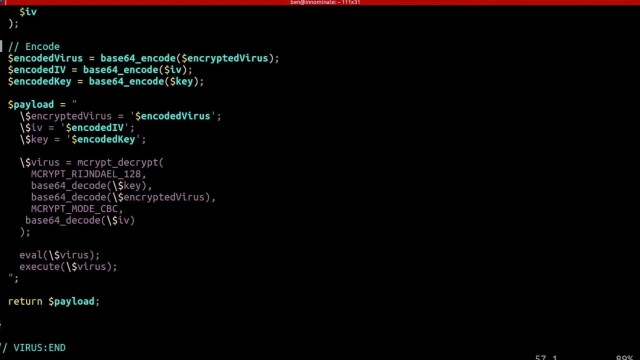
In his talk, “Writing Viruses for Fun, Not Profit,”Ben Dechrai (after making the viewer take a pledge to only use this knowledge for good and not evil) walks through how many viruses operate, and just how easy it is to build your own self-replicating virus in PHP.

The danger of many of these viruses according to Ben is that the most dangerous viruses often escape detection by not looking like a virus. Instead they encrypt their code to hide their true intent, while also constantly adapting and evolving.

Perhaps even more dangerously, they act like they’re benign and don’t actually do anything - often times laying dormant until called upon by the malicious actor.

Creating the Virus

What’s scary is just how simple it was for Ben to create such a virus, one that mutated ever so slightly as it infected every other file on the server. Opening up unlimited possibilities from scraping customer data, to DDOS attacks, to simply hijacking your domain.


But those attacks are just the start as Ben demonstrated how easy it is to write new files, delete files, eval() and execute foreign code - which could even be extended to accessing the underlying server itself if shell_exec() is enabled.

To add to the problem, Ben shares how challenging it can be to identify malicious code on your server as many of these attacks are far more sophisticated than the the virus he created in a matter of minutes - hiding themselves and often appearing as if they are part of the original source code.

Deploying the Virus

To drive his point home, Ben demonstrates how even seemingly secure systems can be vulnerable - as all it takes is one tiny misstep within your application.

He highlights this by building what should be a secure photo gallery - one that checks the extension and mime-type of the image - and even stores it outside of the public directory. He goes even farther by adding additional sanity checks with a PHP script that then renders the image.

After walking through the code and it’s security features, he then downloads a simple image from the internet. Opening his editor he quickly injects the virus (written in PHP) into the image and uploads it, passing all of the server checks.

Surely, since it passed these checks the system is secure, right? Ben loads the gallery to proudly show off the image - which is just that… an image, with nothing special or out of the ordinary.
Except that when he opens the image gallery files, each has been infected with the malicious code.

The culprit that allowed for Ben to hijack an entire system and execute foreign code, create new files, and even hijack the entire site? When displaying the image the file was included using PHP’s include() function, instead of pulling in the data using file_get_contents() and echoing it out.

Such a simple mistake provided Ben, if he was a malicious hacker, complete access to all of the files on the system.

Protecting Yourself

Security always exists in layers - and this could have been prevented by including a few more layers, such as using an open source library to rewrite the image, reviewing the image source before pulling it in, or again not giving it executable access by using the PHP include() function.

But what’s terrifying is how simple it is to hijack a site, how easy it is to get access to your system and private data, and how easy it is to overlook security vulnerabilities - especially with open source tooling and those that take plugins.

As Ben explains, sometimes the core code itself is really secure, but then you get two different plugins that when used together accidentally create a security vulnerability. That by itself is one of the most challenging as you can audit each plugin individually, and still not know you’re opening up your system to malicious actors.

This is why it's not just important to stay up to date on the latest security measures and best practices, but to be constantly thinking like a hacker and testing your code for vulnerabilities.

Learn More

You can watch thefull video to learn more how viruses operate, how to quickly build your own PHP virus (but you must promise to use it for good), and what to watch for in order to protect yourself, your customers, and your architecture.
8402 views · 2 years ago


For any development project to be successful, it’s important to choose the right technology and programming language. Most of the time, developers get confused about which programming language to choose.

Nowadays, PHP and Python have gained popularity among the programming languages for web development projects. However, choosing one between PHP vs Python is a difficult task. Recently, this has become a good topic for discussion.

Here, in this blog, we will compare the two popular programming languages: PHP vs Python. Let’s see which one turns out to be the best choice for web development.


What is Python?

Python is an open-source programming language developed in the year 1991 by Guido Van Rossum. It is one of the most commonly used languages due to its high level and easy-to-understand syntax.

According to the survey by Stack Overflow, Python is one of the most preferred programming languages. These Python app examples highlight its robustness and suitability for building scalable and innovative solutions across different platforms. Most of the companies and developers around the world are using Python web development.

What is PHP?

PHP or Hypertext Pre-processor, is an open-source server scripting language that is used for creating interactive and engaging web pages. This programming language comes with many features, libraries, plugins, and add-ons that increase community support and functionalities.

PHP language was developed by Rasmus Lerdorf in the year 1995. Earlier, PHP was named as Personal Home Page, which was later changed to Hypertext Pre-processor. An advantage of using PHP language is it supports all web browsers.

PHP is a practical, flexible, and fast programming language that can handle dynamic content on HTML sites, session tracking, and databases.

Features: PHP vs Python

PHP

* Open-source language, anyone can download and use it for free.
* PHP is easy to use and code than other programming languages.
* It is more efficient than other scripting languages like ASP and JSP.
* Offers access to log in by creating a summary of the recent user accesses.
* Provides database integration and supports distinct databases such as MySQL and Oracle.
* It has predefined error-reporting constants that generate warning or error messages.

Python

* Python is an easy-to-learn programming language.
* Provides an ideal structure and support for large applications.
* It can operate on different hardware platforms utilizing the same user interface.
* Python can be integrated with C, C++, and Java programming code.
* It’s easy to incorporate low-level modules in Python interpreter.
* Python offers high-level dynamic types of data and support for dynamic type checking.
* Its features support automatic garbage collection.
* It supports an interactive mode of testing and debugging.


Pros and Cons: PHP vs Python

Here, we will compare the pros and cons of PHP vs python for web development.

Pros of PHP

* Has a large ecosystem.
* Flexible and platform-independent.
* Several open-source PHP frameworks are available to use for free.
* Offers many pluggable frameworks, Open-source and object-oriented.
* Supports different database interfaces such as No SQL, PostgreSQL, and so on.
* It is supported by many operating systems and works cross-platform.
* Encourages top-notch debugging.
* Provides in-built SQL support.
* Offers support for database collection modules.
* It supports all operating systems like Windows, Linux, and UNIX.

Cons of PHP

* Delayed and wired performance.
* Not apt for content-based applications.
* Utilizes weak typing that can lead to false knowledge and data to users.
* Its core behavior can’t be changed.
* There’s no IOT alliance.
* Fewer security protocols and features.

Pros of Python

* Easy to learn and maintain.
* An open-source and uniformly unfolding language.
* Enables cross-platform code reusability.
* Object-oriented and versatile language to deploy.
* Offers WORA functionality.
* Helps in developing GUI apps.
* Has automatic garbage collection.
* It can be integrated easily with other languages, such as Java or C++.
* Provides libraries like Tenseorflow for math-intensive tasks.

Cons of Python

* Creates delays in web app testing.
* It utilizes an enormous amount of memory to help developers in easy development.
* Operates slower than other web development languages.
* Not of much use in mobile computing browsers and mobile app development.
* It has dynamic typing, which makes error detection more difficult.
* It’s too large for a simple and small app or website.
* Run time errors occurs due to duck typing.

When Should You Select PHP?

PHP is a commonly used server-side scripting language among developers. The best use cases in which you should select PHP:
* For developing blogs, websites, and web applications.
* Work effectively on the server side.
* Less investment.

When Should You Select Python?

* Python programming language has gained popularity in recent times. Below we have given some of the best cases in which you should choose Python.
* For operating in the areas of robotics and data science.
* When you want accurate and extensive data analytics.
* Developing websites using the Django framework.

Why opt for PHP?

Here, we will give you some reasons why you should opt for the PHP programming language.
* Open-source language, easy to download and use.
* Easy to learn and operates effectively on the server side.
* This scripting language can run on distinct platforms such as Windows, Mac OS X, Linux, and UNIX.
* It’s compatible with every server, like IIS, Apaches, and so on.
* Supports a broad range of databases.

Why opt for Python?

As you know, there are many advantages and disadvantages of using Python. Here, we will tell you why you should choose Python for web development.
* Python language is easy to use and maintain.
* Python syntax is quick to understand and debug as well. Therefore, its source code is easier to maintain.
* It has a garbage collection feature and memory addresses accordingly.
* It comes with many pre-built libraries.
* Python supports GUI apps such as Django, Tkinter, WXPython, etc.
* It’s a versatile and portable language. You can run Python on different types of operating systems or platforms.
* Python comes with a database-friendly interface that can store a colossal amount of data for commercial DBMS systems.
* It has an interactive shell that helps in unit testing before deploying a product.

Comparison: PHP vs Python

Above, we have given the features and pros & cons of PHP vs Python. In this section, we will give you a comparison between PHP vs Python in accordance with different parameters.

Parameters
Python
PHP
Release
    .
    .
Learning curve
Easier
Steep
Language type
Specialized for web development
General purpose programming language
Syntax
Clear & concise
Complex
Security
High
Medium
Readability
High
Low
Database connectivity
Faster
Slower
Debugging
Fast
Slower
Performance
Lesser support
Faster
Supported Frameworks
Flask, Django, Web2Py
Laravel, Zend, Codelgniter
GitHub Stars
    . 9k
    . 5k
TIOBE Rating
    . st position
    . th position
Forks
    . 5 k
    . 9k
Major Users
Instagram, YouTube, Quora, Reddit
Facebook, Yahoo, Flickr, Tumblr


This comprehensive comparison between PHP vs Python can help you to choose the right language for web development. Now, we will compare some other elements that would give you a clear picture of both PHP vs Python.

1. Ease of Learning

Python is an easier language to learn compared to PHP. If you are a beginner, then Python is a good choice as you can learn it quickly. Python programs are shorter as well as easy to write in comparison to other languages.

PHP programming language is made for creating sophisticated web apps. It’s not a general-purpose language, and it takes time to learn it.

2. Ease of Use

Python is an open-source programming language that is versatile and portable. Python’s syntax is simple, and coding is easy to learn compared to PHP. But PHP is not just an ordinary programming language it’s used for creating dynamic web pages with HTML. This makes PHP more difficult to use than Python.

3. Community Support

Both PHP and Python provide good community support. PHP has been in the market for a long time and has a large community of developers. Therefore, you can immediately get support if you opt for PHP.

However, there are even many Python developers who constantly develop python apps. So, the community support in Python is also good. Consequently, we can’t say whether PHP or Python is better at providing community support.

4. Flexibility

Nowadays, web apps backed by Machine Learning are in high demand. Also, ML is a significant part of Python. Python provides many machine-learning libraries, such as Tensorflow, Theano, Pandas, and Scikit-learn. Additionally, these libraries are rapid, unique, & robust and work effectively with a web framework.

Nonetheless, Python programming language can be used in many other fields apart from web development. But when it comes to PHP, it’s best for web development. Therefore, we can say Python is a better choice here.

Our skilled developers delivers the most promising web development firms to make dynamic websites for your business.

5. Speed to Market

Python provides a comprehensive set of modules and third-party libraries to help developers finish the project faster. One of the popular web frameworks written in Python is Django. It utilizes the MVC pattern to allow developers to create apps fast using a significant division of concerns and reusability.

PHP also has a vast set of tools, frameworks, and libraries. Laravel is a popular PHP framework that allows the MVC pattern. Additionally, it comes with many helpful functionalities for web development, like routing, templating, authentication, and so on.

6. Web Frameworks

You get robust and well-designed web development frameworks both in PHP and Python. Most of the big businesses utilize web frameworks that PHP provides. For example, Laravel and Symfony are mature web frameworks, and a huge community supports them. So, we can say PHP makes web development easy.

Python also has many exceptional frameworks that are highly scalable, easy to use, fast and secure. It’s two most popular web frameworks are Flask and Django. If you want a shorter development period, then you can choose Django over PHP-based frameworks.

7. Library Management

Python uses Pip to handle and deal with packages. Pip ensures that Python app development is easy, rapid, and meets development needs. Python has powerful library management compared to PHP. It has a wide range of packages and tools that assist and make web app development easier. So, in terms of library management, Python clearly wins it.

8. Security

When it comes to security, most businesses prefer using Python. For instance, Django offers many pre-built security features that aid in safeguarding the apps from distinct security breaches & threats.

Apart from that, many government organizations rely on Python as their secret hacking tool. Most of the security problems are addressed by its large community support. However, PHP is less strong than Python in aspects of security.

9. Environment Management

In terms of handling environments, Python is the best programming language. It has a Virtualenv system that aids in installing different versions of the language and switching between them immediately.
PHP has no comparison with Python when it comes to handling environments. There’s an analog of PHP, VirtPHP, but it’s archived and not maintained. Therefore, most of the developers opt for Python.

10. Debugging

Python has an in-built debugger called Python Debugger or PDB. It utilizes many debugging strategies. PDB enables dynamic typing and lets developers work effortlessly without stating things at the start of a program.
PHP also comes with an XDebug package for handling bugs and error-checking the codes. But PHP development is quite slow in identifying and removing bugs. Therefore, it often experiences security issues.


The Bottom Line PHP vs Python: Which One You Choose for Web Development?


From the blog, you must have inferred that both PHP and Python are good for web development. However, there are many aspects in which Python wins over PHP. But this doesn’t mean that you only have to opt for Python. The selection of programming language majorly depends on the complexity and needs of the project.

Sphinx Solutions is a leading and trusted web app development company. Our team of web developers can help you create the best web apps for your business based on your specifications. Schedule a call with our experts to get an estimation for your web app development project, or email us at [email protected].

PHP vs Python: FAQs

1. Why choose Python over PHP?
Python is chosen over PHP for web app development due to many reasons, such as ease to use, simple syntax, flexibility, security, high performance, etc.
2. Which programming language is secure: PHP vs Python?
Python is a preferred programming language when it comes to security as it has many security features compared to PHP.
3. Why is Python used mostly?
Python is a general-purpose programming language and is utilized in web development, mobile app development, AI, ML, game development, big data, and so on.
Browse More Related Article
    . React and Nodejs: The Best Combination for Web Application Development
    . A Timeless Guide on How to Expand Your Native App to a Web App
51356 views · 7 years ago
Securing PHP RESTful APIs using Firebase JWT Library

Hello Guys,

In our Last Blog Post, we have created restful apis,But not worked on its security and authentication. Login api can be public but after login apis should be authenticate using any secure token. one of them is JWT, So i am providing the Steps for Create and use JWT Token in our already created API.


Now its time To Implement JWT Authentication IN our Api, So these are the steps to implement it in our already created Apis


Step 1:Install and include Firebase JWT(JSON WEB TOKEN) in our project with following composer command        


 composer require firebase/php-jwt 


include the composer installed packages
require_once('vendor/autoload.php');


use namespace using following:
 use \Firebase\JWT\JWT; 


Step 2: Create a JWT server side using Firebase Jwt Library's encode method in Login action , and return it to Client


Define a private variable named Secret_Key in Class like following:

 private {
$payload = array(
'iss' => $_SERVER['HOST_NAME'],
'exp' => time()+600, 'uId' => $UiD
);
try{
$jwt = JWT::encode($payload, $this->Secret_Key,'HS256'); $res=array("status"=>true,"Token"=>$jwt);
}catch (UnexpectedValueException $e) {
$res=array("status"=>false,"Error"=>$e->getMessage());
}
return $res;
}


In our login action , if the user has been logged in successfully then with the status,_data_ and message just replace the login success code with following code:

$return['status']=1;
$return['_data_']=$UserData[0];
$return['message']='User Logged in Successfully.';

$jwt=$obj->generateToken($UserData[0]['id']);
if($jwt['status']==true)
{
$return['JWT']=$jwt['Token'];
}
else{
unset($return['_data_']);
$return['status']=0;
$return['message']='Error:'.$jwt['Error'];
}


Step 3: Now with every request after login should have the JWT token in its Post(even we can receive it in get or authentication header also but here we are receiving it in post)


No afetr successfully login you will get the JWt Token in your response,Just add that Token with every post request of after login api calls. So we will do it using postman, Find the screenshot 1 for checking the JWT Token is coming in login api response

JWT DEMO LOGIN API RESPONSE


Step 4:After reciving the JWt in every after login api call, we need to check whether the token is fine using JWT decode method in After login Apis like
UserBlogs
is a After login Api, So for verify that we are creating Authencate method in class like following:


 public function Authenticate($JWT,$Curret_User_id)
{
try {
$decoded = JWT::decode($JWT,$this->Secret_Key, array('HS256'));
$payload = json_decode(json_encode($decoded),true);

if($payload['uId'] == $Curret_User_id) {
$res=array("status"=>true);
}else{
$res=array("status"=>false,"Error"=>"Invalid Token or Token Exipred, So Please login Again!");
}
}catch (UnexpectedValueException $e) {
$res=array("status"=>false,"Error"=>$e->getMessage());
}
return $res;

}


Step 5: Cross check the response returned by Authenticate method in
UserBlogs
Action of api , replace the
UserBlogs
Action inner content with following code:


 if(isset($_POST['Uid']))
{

$resp=$obj->Authenticate($_POST['JWT'],$_POST['Uid']);
if($resp['status']==false)
{
$return['status']=0;
$return['message']='Error:'.$resp['Error'];
}
else{
$blogs=$obj->get_all_blogs($_POST['Uid']);
if(count($blogs)>0)
{
$return['status']=1;
$return['_data_']=$blogs;
$return['message']='Success.';
}
else
{
$return['status']=0;
$return['message']='Error:Invalid UserId!';
}
}
}
else
{
$return['status']=0;
$return['message']='Error:User Id not provided!';
}


Ah great its time to check out the UserBlogs Api, please find the screenshoot for that, Remember we need to put the JWt Token in POST Parameter as we have already recived that Value in Login Api call.

JWT DEMO Authentication in userBlogs API Call

Now if you want to verify that token is expiring in given time(10 minutes after generation time/login time), i am just clicking the same api with same token after 10 minutes and you can see there will not return any data and it is returning status false with following message :


JWT DEMO Authentication in userBlogs API Call


Also if you want to eloborate it more then i suggest you to try with modify Uid value with same token , you will another authentication issue and also if you modify the JWT token also then also you will not get the desired result and get authentication Issue

Thanks for reading out if you want the complete code of this file then please find following:
<?php 
header("Content-Type: application/json; charset=UTF-8");
require_once('vendor/autoload.php');
use \Firebase\JWT\JWT;

class DBClass {

private $host = "localhost";
private $username = "root";
private $password = ""; private $database = "news";

public $connection;

private $Secret_Key="*$%43MVKJTKMN$#";
public function connect(){

$this->connection = null;

try{
$this->connection = new PDO("mysql:host=" . $this->host . ";dbname=" . $this->database, $this->username, $this->password);
$this->connection->exec("set names utf8");
}catch(PDOException $exception){
echo "Error: " . $exception->getMessage();
}

return $this->connection;
}

public function login($email,$password){

if($this->connection==null)
{
$this->connect();
}

$query = "SELECT id,name,email,createdAt,updatedAt from users where email= ? and password= ?";
$stmt = $this->connection->prepare($query);
$stmt->execute(array($email,md5($password)));
$ret= $stmt->fetchAll(PDO::FETCH_ASSOC);
return $ret;
}

public function get_all_blogs($Uid){

if($this->connection==null)
{
$this->connect();
}

$query = "SELECT b.*,u.id as Uid,u.email as Uemail,u.name as Uname from blogs b join users u on u.id=b.user_id where b.user_id= ?";
$stmt = $this->connection->prepare($query);
$stmt->execute(array($Uid));
$ret= $stmt->fetchAll(PDO::FETCH_ASSOC);
return $ret;
}

public function response($array)
{
echo json_encode($array);
exit;
}

public function generateToken($UiD)
{
$payload = array(
'iss' => $_SERVER['HOST_NAME'],
'exp' => time()+600, 'uId' => $UiD
);
try{
$jwt = JWT::encode($payload, $this->Secret_Key,'HS256'); $res=array("status"=>true,"Token"=>$jwt);
}catch (UnexpectedValueException $e) {
$res=array("status"=>false,"Error"=>$e->getMessage());
}
return $res;
}

public function Authenticate($JWT,$Current_User_id)
{
try {
$decoded = JWT::decode($JWT,$this->Secret_Key, array('HS256'));
$payload = json_decode(json_encode($decoded),true);

if($payload['uId'] == $Current_User_id) {
$res=array("status"=>true);
}else{
$res=array("status"=>false,"Error"=>"Invalid Token or Token Exipred, So Please login Again!");
}
}catch (UnexpectedValueException $e) {
$res=array("status"=>false,"Error"=>$e->getMessage());
}
return $res;

}
}

$return=array();
$obj = new DBClass();
if(isset($_GET['action']) && $_GET['action']!='')
{
if($_GET['action']=="login")
{
if(isset($_POST['email']) && isset($_POST['password']))
{
$UserData=$obj->login($_POST['email'],$_POST['password']);
if(count($UserData)>0)
{
$return['status']=1;
$return['_data_']=$UserData[0];
$return['message']='User Logged in Successfully.';

$jwt=$obj->generateToken($UserData[0]['id']);
if($jwt['status']==true)
{
$return['JWT']=$jwt['Token'];
}
else{
unset($return['_data_']);
$return['status']=0;
$return['message']='Error:'.$jwt['Error'];
}

}
else
{
$return['status']=0;
$return['message']='Error:Invalid Email or Password!';
}
}
else
{
$return['status']=0;
$return['message']='Error:Email or Password not provided!';
}
}
elseif($_GET['action']=="UserBlogs")
{
if(isset($_POST['Uid']))
{

$resp=$obj->Authenticate($_POST['JWT'],$_POST['Uid']);
if($resp['status']==false)
{
$return['status']=0;
$return['message']='Error:'.$resp['Error'];
}
else{
$blogs=$obj->get_all_blogs($_POST['Uid']);
if(count($blogs)>0)
{
$return['status']=1;
$return['_data_']=$blogs;
$return['message']='Success.';
}
else
{
$return['status']=0;
$return['message']='Error:Invalid UserId!';
}
}
}
else
{
$return['status']=0;
$return['message']='Error:User Id not provided!';
}
}
}
else
{
$return['status']=0;
$return['message']='Error:Action not provided!';
}
$obj->response($return);
$obj->connection=null;
?>

11902 views · 7 years ago
Conferences are always looking for speakers - it can be hard to keep track of them all and the requirements they have. I wanted to put together this quick guide to make it easy for you to apply. Make sure to apply because as Wayne Gretzky said “You miss 100% of the shots you don’t take”!!!

phpDay 2019

First we have phpDay 2019 which will take place on May 10 & 11 at Hotel San Marco in Verona, Italy. Some facts about this call for papers:
*Submission deadline: February 4, 2019
*Submit via: https://cfp.phpday.it/
* For more info on the conference: https://2019.phpday.it/
* Twitter: (@phpday)
* Speaker package includes: Full conference pass (jsDay + phpDay), speaker dinner the first night, lunch, reception and activities included in regular conference.
* For speakers remote to the Area: A refund of up to €200 for travel costs (or €500 from US or extra-EU), 2 complimentary hotel nights (+1 hotel night for speakers presenting multiple talks or US/extra-EU) and Taxi fare from/to the airport.
*In Submission: make sure your talk title and abstract define the exact topic you want to talk about and what you hope people will learn from the session.
*Talk Ideas: APIs (REST, SOAP, etc.), Architectures, Continuous Delivery, Databases, Development, Devops, Frameworks, Internals, PHP 7.x / PHP 8, Security, Testing and UI/UX.

ScotlandPHP

Next we have ScotlandPHP which will take place on November 8 & 9 at Edinburgh International Conference Centre in Edinburgh, Scotland.
*Submission deadline: April 22, 2019
*Submit via: https://cfs.scotlandphp.co.uk/
* For more info on the conference: https://conference.scotlandphp.co.uk/
* Twitter: (@scotlandphp)
* Speaker package: Full conference pass, lunch, receptions and activities included in regular conference.
* For speakers remote to the Area: Complimentary airfare/travel, 2 complimentary hotel nights and we'll pick you up and drop you off to/from the airport so you don't have to worry about it.
* Speakers will be provided with a projector, a wireless lapel microphone and a screen for their presentation (size depends on the room). Speakers should bring any equipment they need to connect to projectors (VGA). It is also suggested that you reduce your dependency on the in-house internet connection as possible. We will however provide HDMI and Mini Display Port connections for all speakers on request. If you need something different or your selected talk needs audio equipment just let us know. We'll work it out.
* Looking for talks and workshops (November 8th).
*Talk Ideas: Virtualization and environments, Javascript, Alternate PHP run-times, PHP internals, Development principles, Security, Mobile-first design, Testing (unit, functional, etc.), Version control, User Experience/Usability, Building APIs (REST, SOAP, whatever), Continuous Integration, Framework-related topics, and Professional development.

Global diversity CFP day

In 2019 there will be numerous workshops hosted around the globe encouraging and advising newbie speakers to put together your very first talk proposal and share your own individual perspective on any subject of interest to people in tech.
* Twitter: (@gdcfpday)
*Save the Date: March 2, 2019
*Register here: https://www.globaldiversitycfpday.com/?utm_source=scotphp

CoderCruise

Then there is CoderCruise which will take place on August 19-23. It's a cruise that takes off from Port Canaveral, Florida and goes to the Bahamas.
* Twitter: (@codercruise)
*Submission deadline: March 3, 2019
*Submit via: https://www.papercall.io/codercruise-2019
* For more info on the conference: https://www.codercruise.com/
* This is a polyglot conference so looking for speakers on a wide variety of languages (PHP, JavaScript, Java, Python, etc.) and on various tech topics.

PHP Conference Asia 2019

There is also PHP Conference Asia 2019, which will take place on June 24-25 at Microsot Singapore.
*Submission deadline: March 8, 2019
*Submit via: https://cfp.phpconf.asia/
* For more info on the conference: https://2019.phpconf.asia/
* Twitter: (@PHPConfAsia)
* Speaker package includes: Speaker package: Full conference pass, lunch, receptions and activities included in regular conference. We'll pick you up and drop you off to/from the airport so you don't have to worry about it. Speakers' dinner on the first evening of the conference (24th June 2019). Transport to and from the conference venue will be included
* For speakers remote to the Area: 2 complimentary hotel nights and
we can consider providing grants to partially cover the air-fare for speakers who might have financial difficulties. This is on a case-by-case basis.
* Speakers will be provided with a projector, a wireless hand-held microphone and a screen for their presentation. Speakers should prepare their slides in 4x3 aspect ratio. Speakers should bring any equipment they need to connect to projectors (HDMI). It is also suggested that you reduce your dependency on the in-house internet connection as possible.
*In Submission: Make sure your talk title and abstract define the exact topic you want to talk about and what you hope people will learn from the session.
*Talk Ideas: Virtualization and environments, Javascript, Alternate PHP run-times, PHP internals, Development principles, Security, Mobile-first design, Testing (unit, functional, etc.), Version control, User Experience/Usability, Building APIs (REST, SOAP, whatever), Continuous Integration, Framework-related topics, and Professional development.

Cascadia PHP

Another conference to apply to is Cascadia PHP, which will take place on September 19-21 at University Place Hotel & Conference Center in Portland, Oregon.
*Submission deadline: April 15, 2019
*Submit via: https://cfp.cascadiaphp.com/
* For more info on the conference: https://www.cascadiaphp.com/venue
* Twitter: (@CascadiaPHP)
* Speaker package includes: Speaker package: Full conference pass, lunch, receptions and activities included in regular conference. For speakers remote to the Area: Complimentary airfare/travel, 2 complimentary hotel nights and we'll pick you up and drop you off to/from the airport so you don't have to worry about it.
Speakers will be provided with a projector, a wireless lapel microphone and a screen for their presentation (size depends on the room). Speakers should bring any equipment they need to connect to projectors (VGA). It is also suggested that you reduce your dependency on the in-house internet connection as possible.
*In Submission: make sure your talk title and abstract define the exact topic you want to talk about and what you hope people will learn from the session.
*Talk Ideas: PHP internals, Version control, Framework-related topics, Building APIs (REST, SOAP, whatever), Mobile-first design, Professional development, Testing (unit, functional, etc.), Alternate PHP run-times, Development principles, Continuous Integration, Getting involved in the PHP community, User Experience/Usability, Technology at large, Security, Connecting to Different APIs, Development Tools, Virtualization and environments, Javascript, Modern hosting practices, Language Features, Databases, Refactoring legacy applications, Running/contributing to open source projects, AI and AR, and User Groups.

Nomad PHP

Last but not least - this is an ongoing call for papers. This is perfect if you want to present from the comfort of your office, home or really wherever you are. It’s via RingCentral meetings and will be live and recorded. This is for none other than Nomad PHP.
* Twitter: (@nomadphp)
* Deadline: Anytime :D
* Talk length: 45 - 60 minutes.
* Talks should be unique to Nomad PHP and not available in video format online.
* Talk should not be recorded or made available elsewhere online for at least 3 months following your talk.
* The talk will be featured on our page and promoted via social media.
* Speakers will receive a financial stipend.
* Upon being selected we will reach out with further details.
*Talk ideas: AI & Machine Learning, APIs, Containerization, Databases, DevOps, Documentation, Frameworks, Performance, Security, Serverless, Testing, Tools, Upgrading/ Modernization, and more.
*Submit here: https://www.papercall.io/nomadphp
Now that you have some information - make sure to apply to all of these options! Can't wait to see all of your awesome talks you present :D!

SPONSORS